Home Page
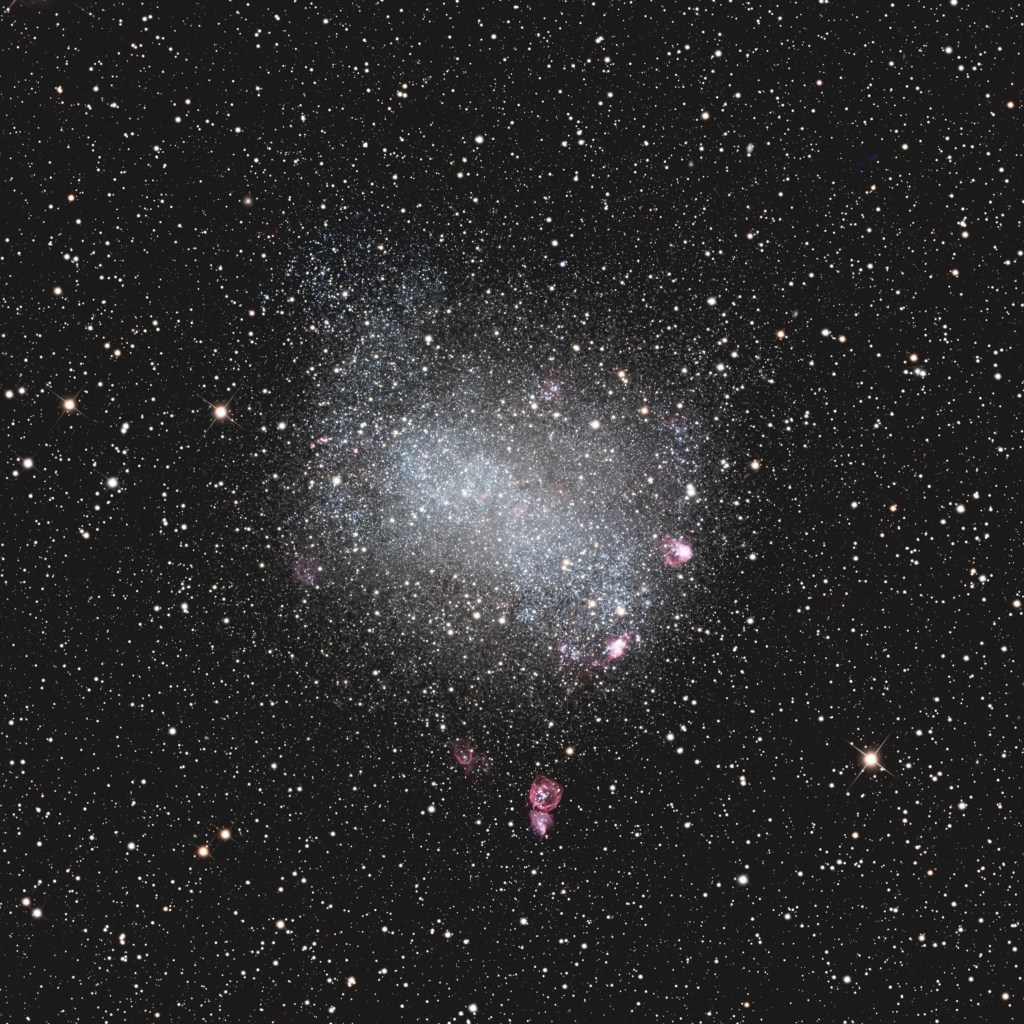
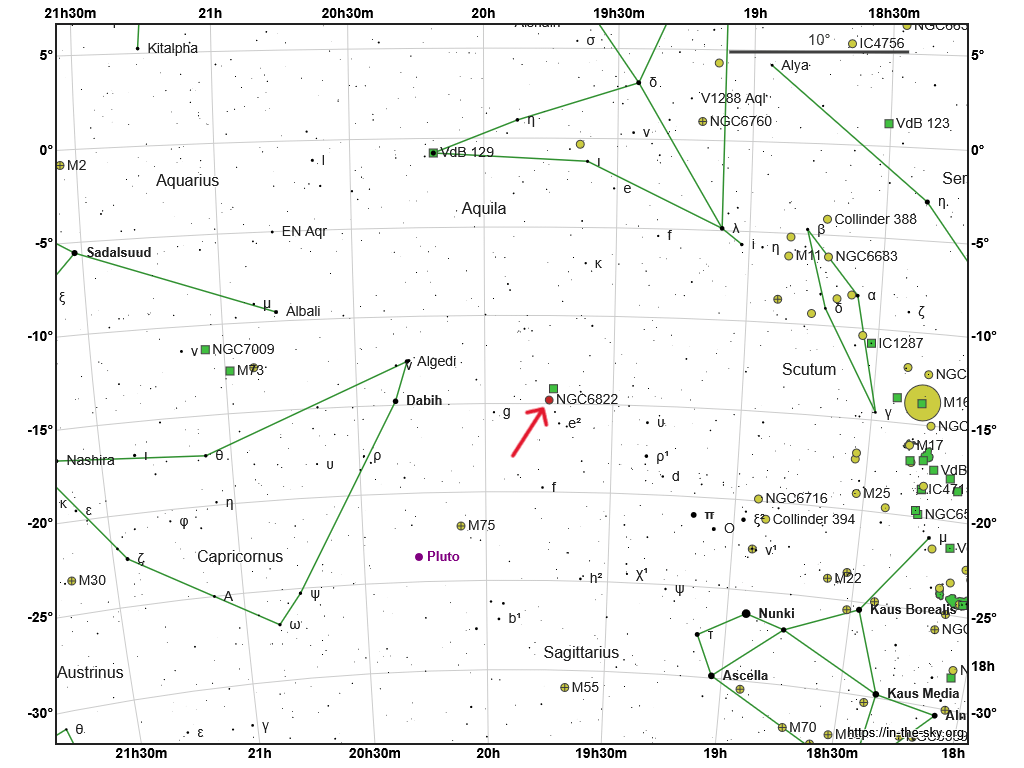
NGC6822, also known as the Barnard’s Galaxy, is a Type IB(s)m a barred irregular galaxy, 1.6 million light-years from Earth in constellation Sagittarius and its diameter is 7,000 light-years. NGC6822’s apparent magnitude is 9.3 and was discovered by E. E. Barnard in 1884.
NGC891 is the closest non-satellite galaxy to the Milky Way, but lies just outside its virial radius. It is similar in structure and composition to the Small Magellanic Cloud.
Edwin Hubble, identified 15 variable stars (11 of which were Cepheids) in this galaxy. He also surveyed the galaxy’s stars distribution down to magnitude 19.4. He provided spectral characteristics, luminosities and dimensions for the five brightest “diffuse nebulae” (giant H II regions) that included the Bubble Nebula and the Ring Nebula. He also computed the absolute magnitude of the entire galaxy.
Hubble’s detection of eleven Cepheid variable stars was a milestone in astronomy. Utilizing the Cepheid Period-Luminosity relationship, Hubble determined a distance of 698,000 light-years. This was the first system beyond the Magellanic Clouds to have its distance determined. (Hubble continued this process with the Andromeda Galaxy and the Triangulum Galaxy). This distance to the galaxy was way beyond Harlow Shapley’s value of 300,000 light-years for the size of the universe. In the paper, Hubble concluded the “Great Debate” of 1920 between Heber Curtis and Shapley over the scale of the universe and the nature of the “spiral nebula”. It soon became evident that all spiral nebulae were in fact spiral galaxies far outside our own Milky Way.
The list below exhibits the number of subframes used with the exposure time for each filter. All the subframes were calibrated with Flats, Darks and Biases by PixInsight. Afterwards the subframes were combined and processed to the final image.
- Luminous 37 x 600s
- Red* 21 x 450s
- Green* 22 x 450s
- Blue* 22 x 450s
- Ha* 20 x 600s
* 2×2 binned
Total time for collecting data for this image is 17.6 hours over two years because it’s available a short time in the low horizon at end of August.
 Frank's Observatory