Home Page
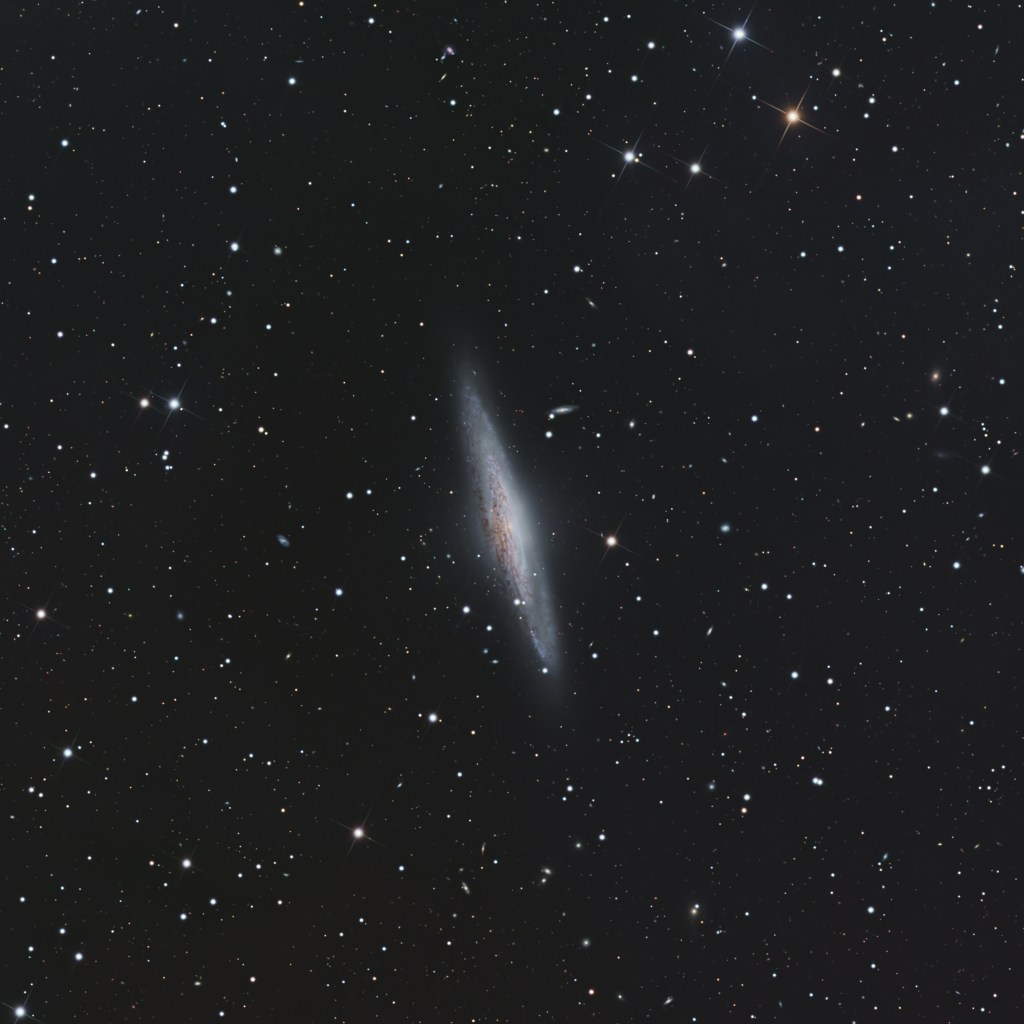
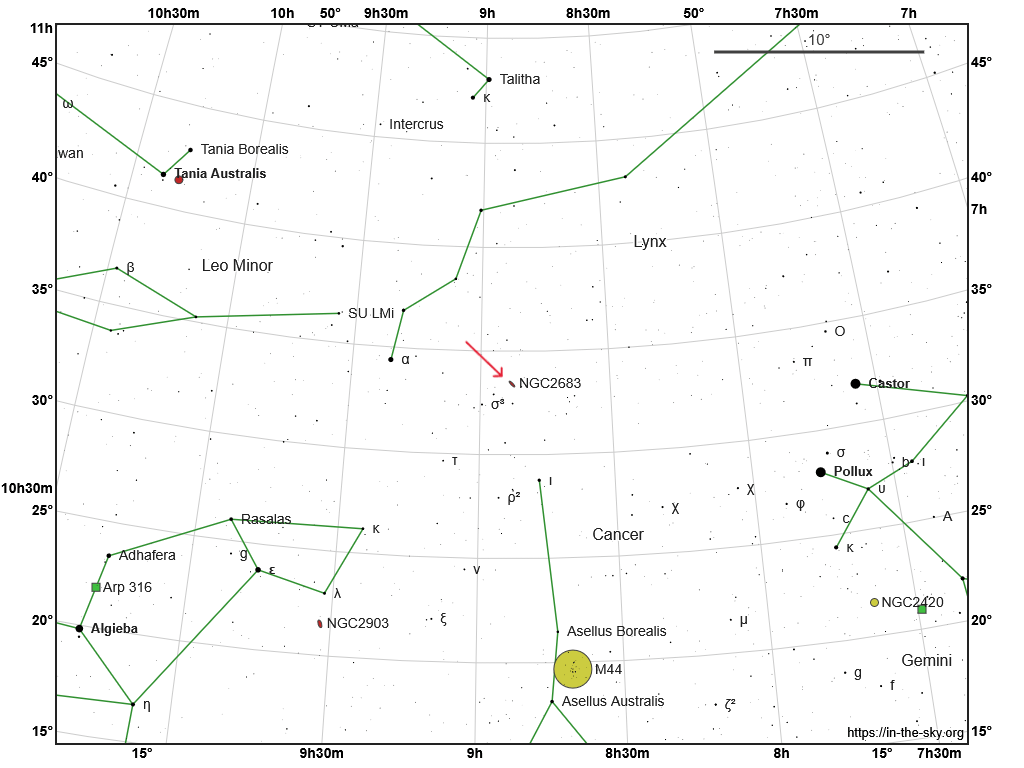
NGC2683 is a field galaxy spiral, type SA(rs)b that is 30.5 million light-years from Earth in constellation Lynx. NGC2683’s apparent magnitude is 10.9 and was discovered by William Hershel in February 1788.
While usually considered an unbarred spiral galaxy, recent research suggests it may in fact be a barred spiral galaxy; its bar is hard to see due to its high inclination. Further support for the presence of a bar stems from the X-shaped structure seen near its center, which is thought to be associated with a buckling instability of a stellar bar.
It is also both smaller and less luminous than the Milky Way with very little neutral hydrogen or molecular hydrogen and a low luminosity in the infrared, which suggests a currently low rate of star formation.
NGC2683 is rich in globular clusters, hosting about 300 of them, twice the number found in the Milky Way. Due to its vast distance and complexity (due to the association of globular clusters bound to it), NGC2638’s mass has not been calculated as accurately as it could be. Otherwise its volume and vector motions are reasonably well known and characterized.
The list below exhibits the number of subframes used with the exposure time for each filter. All the subframes were calibrated with Flats, Darks and Biases by PixInsight. Afterwards the subframes were combined and processed to the final image.
- Luminous 33 x 600s
- Red* 15 x 450s
- Green* 15 x 450s
- Blue* 16 x 450s
* 2×2 binned
Total time for collecting data for this image is 11 hours.
 Frank's Observatory