Home Page
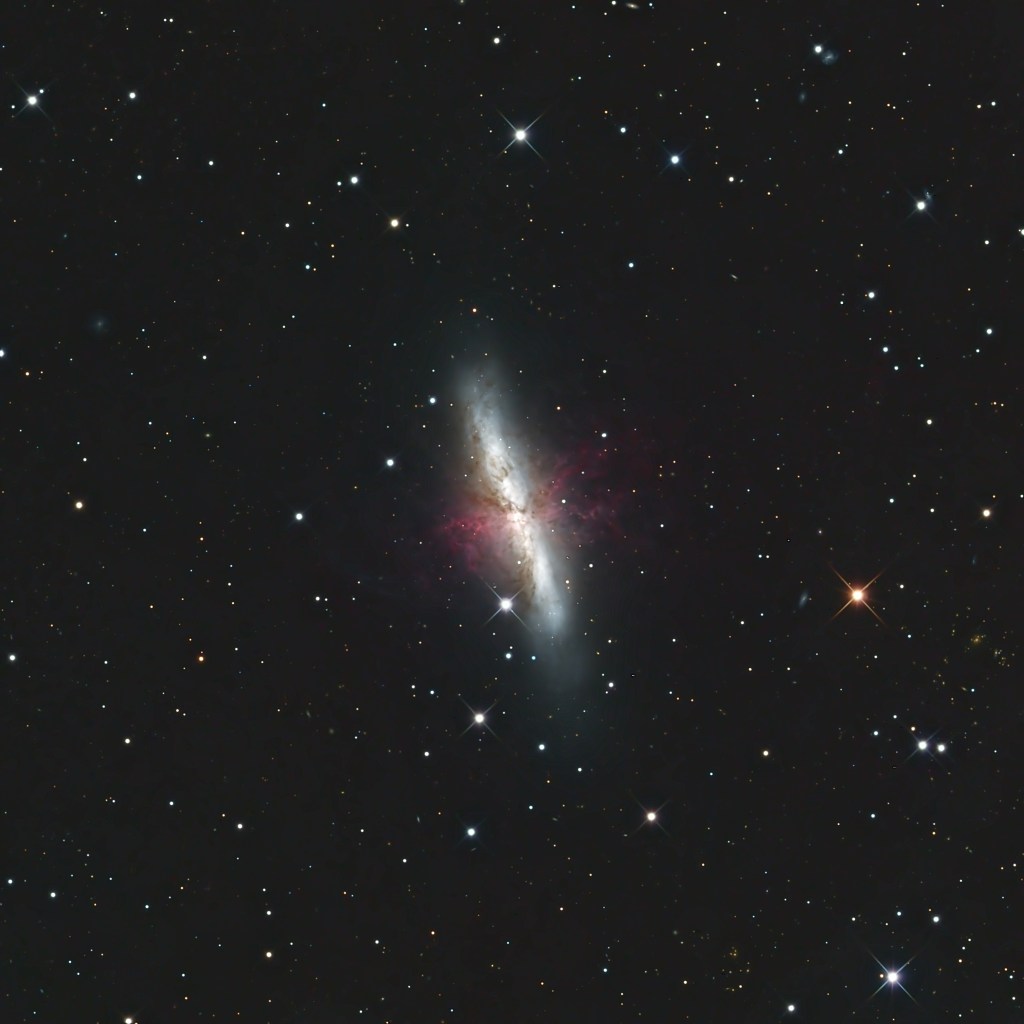
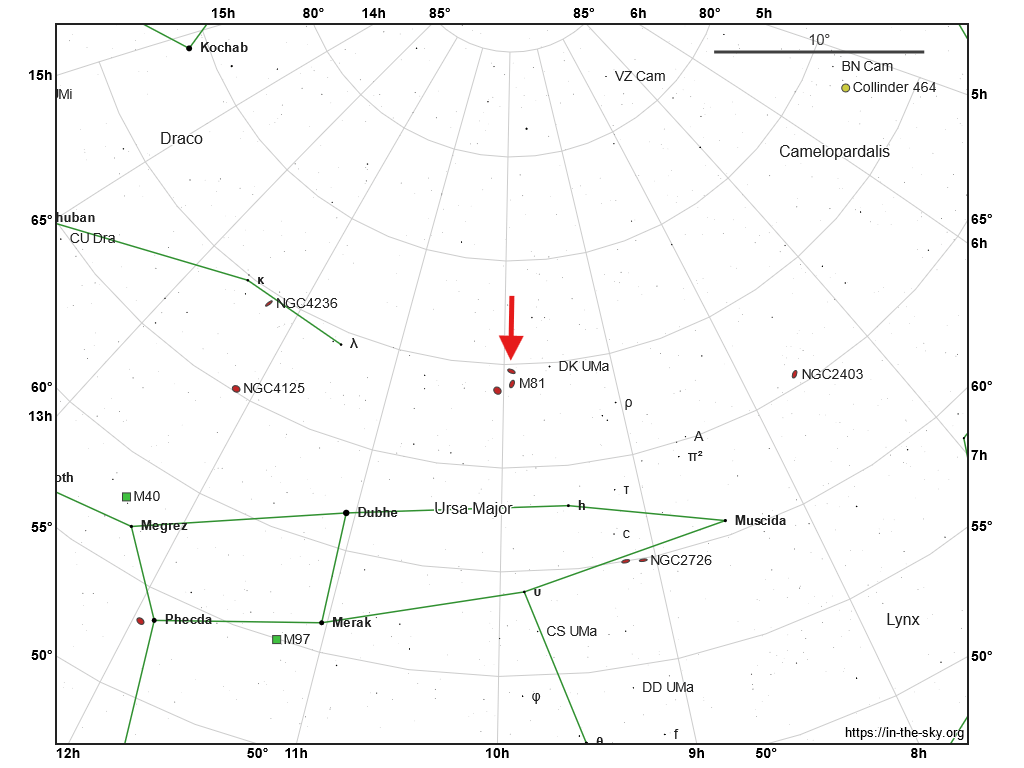
M82, also known as the Cigar Galaxy, is a Type IO irregular approximately 12 million light-years from Earth in constellation Ursa Major. It is the second larger of the M81 Group, with its diameter of 40,800 light-years. The galaxy is 5 times more luminous than our Milky Way and its central region is about one hundred times more luminous. This galaxy, along with M81, was discovered by a German astronomer Johan Elert Bode in 1774. In 1779, Pierre Méchain and Charles Messier rediscovered M82, along with M81, and listed them in the Messier Catalogue.
M82, the second largest member of the M81 Group, is being physically affected by its larger neighbor, the spiral M81. Tidal forces caused by gravity have deformed M82, a process that started about 100 million years ago. This interaction has caused some interstellar gas to fall into the center, which causes star formation to increase tenfold compared to “normal” galaxies. In 2005, the Hubble Space Telescope revealed 197 massive young clusters in the starburst core. The average mass of these clusters is around 200,000 solar masses; hence the starburst core is a very energetic and high-density environment. Throughout the galaxy’s center, young stars are being born 10 times faster than they are inside the entire Milky Way Galaxy.
The list below exhibits the number of subframes used with the exposure time for each filter. All the subframes were calibrated with Flats, Darks and Biases by PixInsight. Afterwards the subframes were combined and processed to the final image.
- Luminous 30 x 600s
- Red* 16 x 450s
- Green* 17 x 450s
- Blue* 16 x 450s
- Ha 22 x 1200s
* 2×2 binned
Total time for collecting data for this image is 18.5 hours.
 Frank's Observatory