Home Page
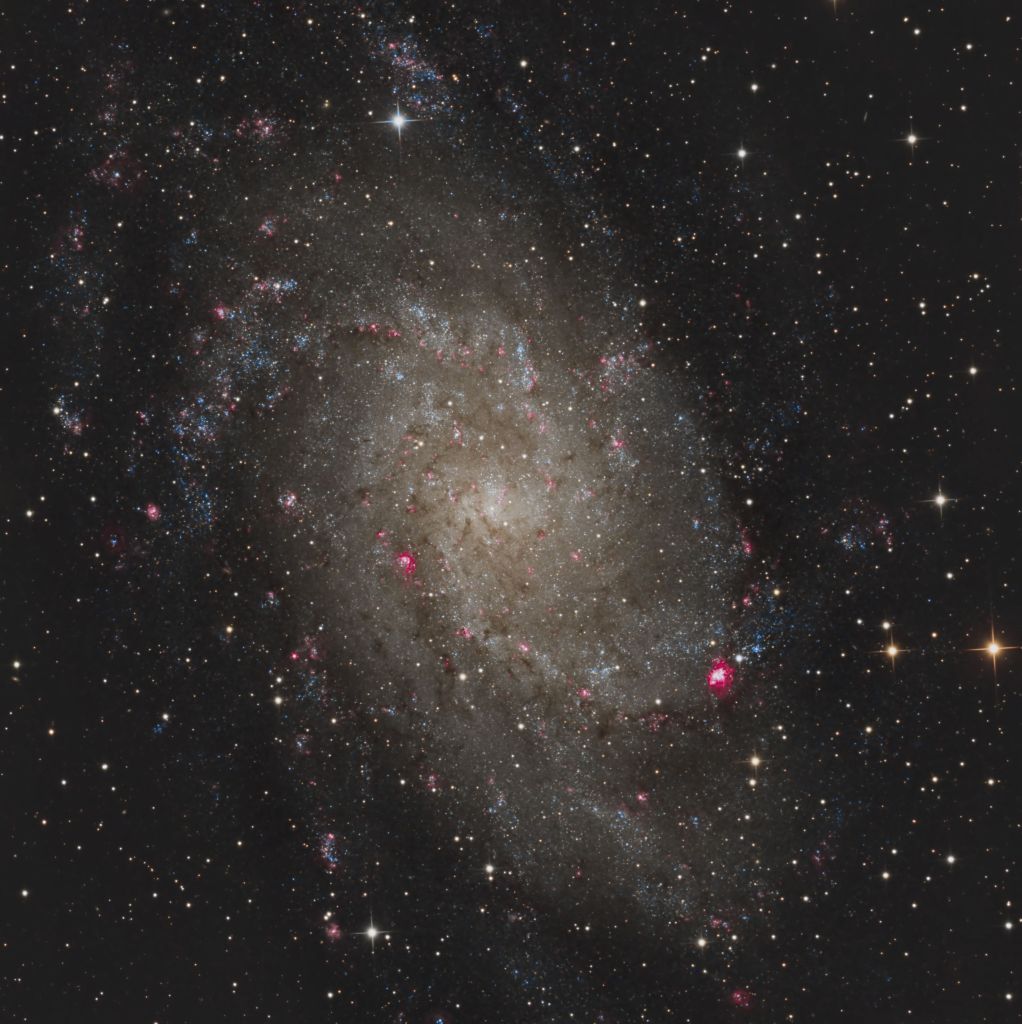
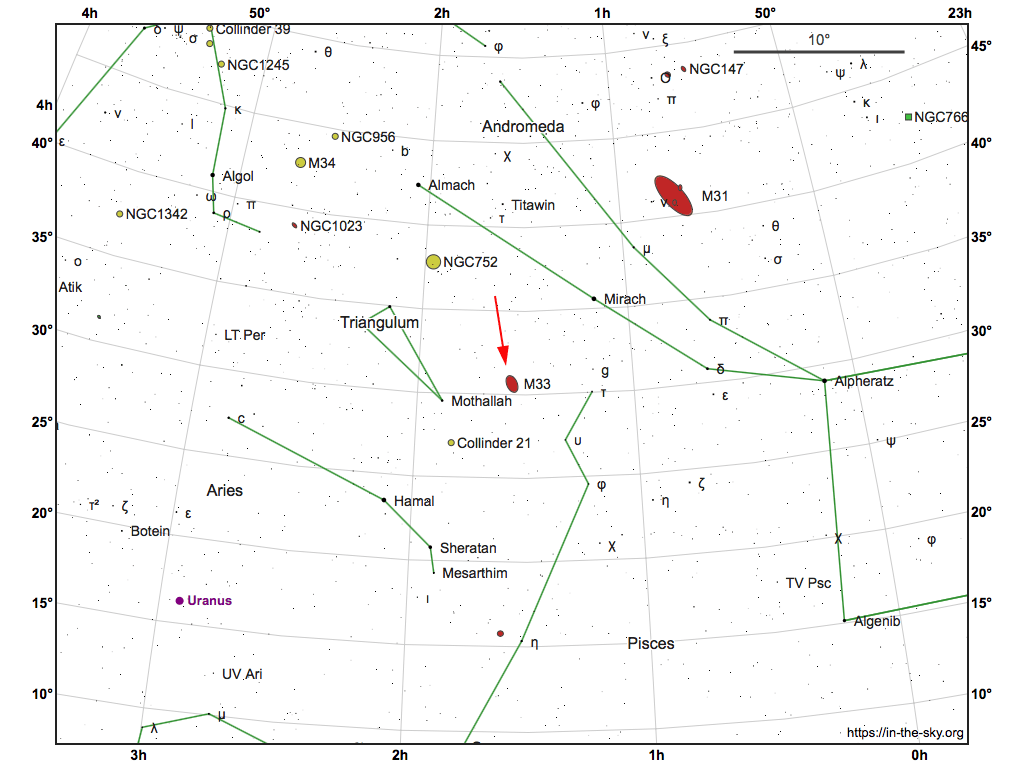
M33, also known as the Triangulum Galaxy, is a Type SA(s)cd spiral 3 million light-years from Earth in the constellation Triangulum and its diameter is 61,120 light-years. M106 has a relatively bright apparent magnitude of 5.72 and can be observed with an unaided eye. It is the third-largest member of the Local Group, behind Andromeda Galaxy and our Milky Way. M33 was likely discovered by an Italian astronomer Giovanni Battista Hodierna before 1654, where he references a cloud-like nebulosity in the constellation Triangulum. Charles Messier discovered this galaxy in 1764 and named it object M33 in the Messier Catalogue.
There are many blue-colored regions throughout the galaxy which reveals numerous sites of rapid star births, whose star formation is ten times higher than the average found in Andromeda. Edwin Hubble observed dozens of variable stars in M33 during the 1920s. This helped him estimate the galaxy’s distance and proved it is its own separate galaxy outside our own.
The list below exhibits the number of subframes used with the exposure time for each filter. All the subframes were calibrated with Flats, Darks and Biases by PixInsight. Afterwards the subframes were combined and processed to the final image.
- Luminous 30 x 600s
- Red* 16 x 450s
- Green* 15 x 450s
- Blue* 15 x 450s
- Ha 17 X 1200s
* 2×2 binned
Total time for collecting data for this image is 17 hours.
 Frank's Observatory