Home Page
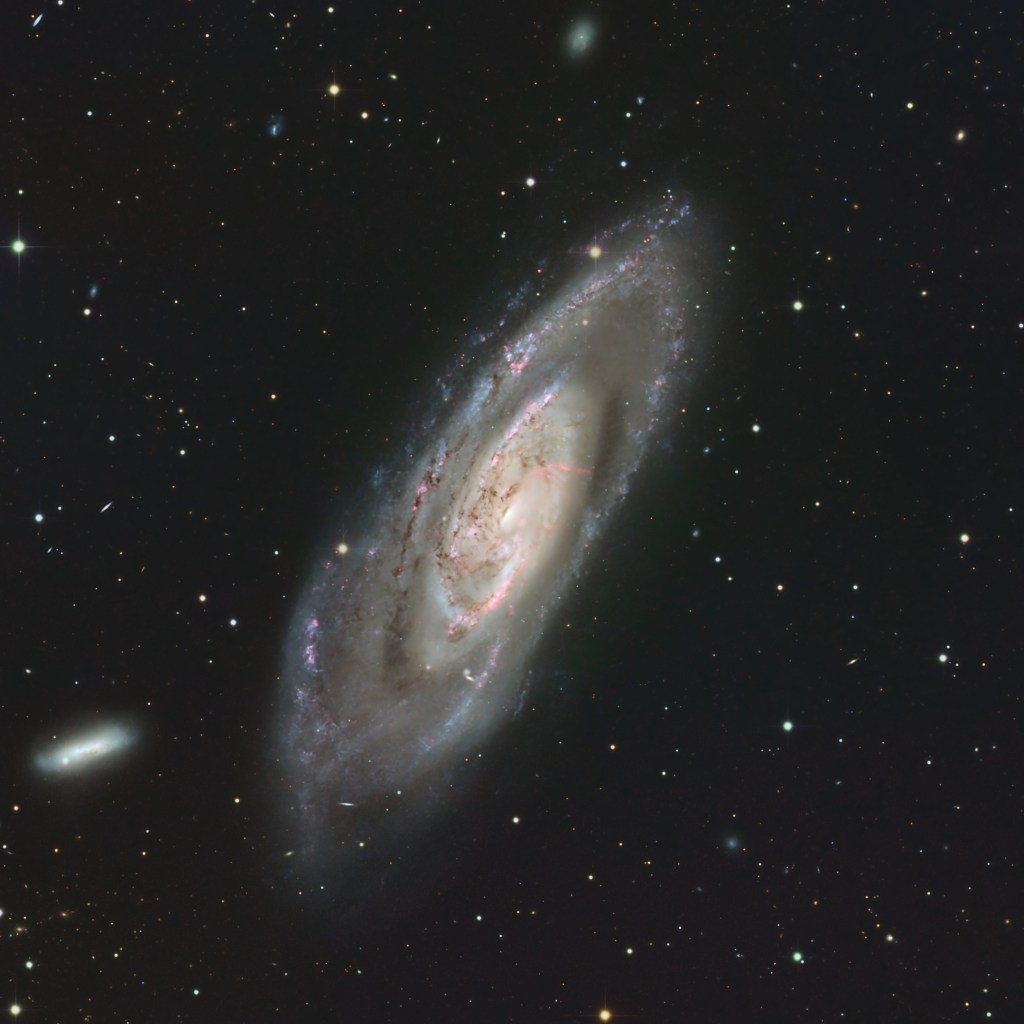
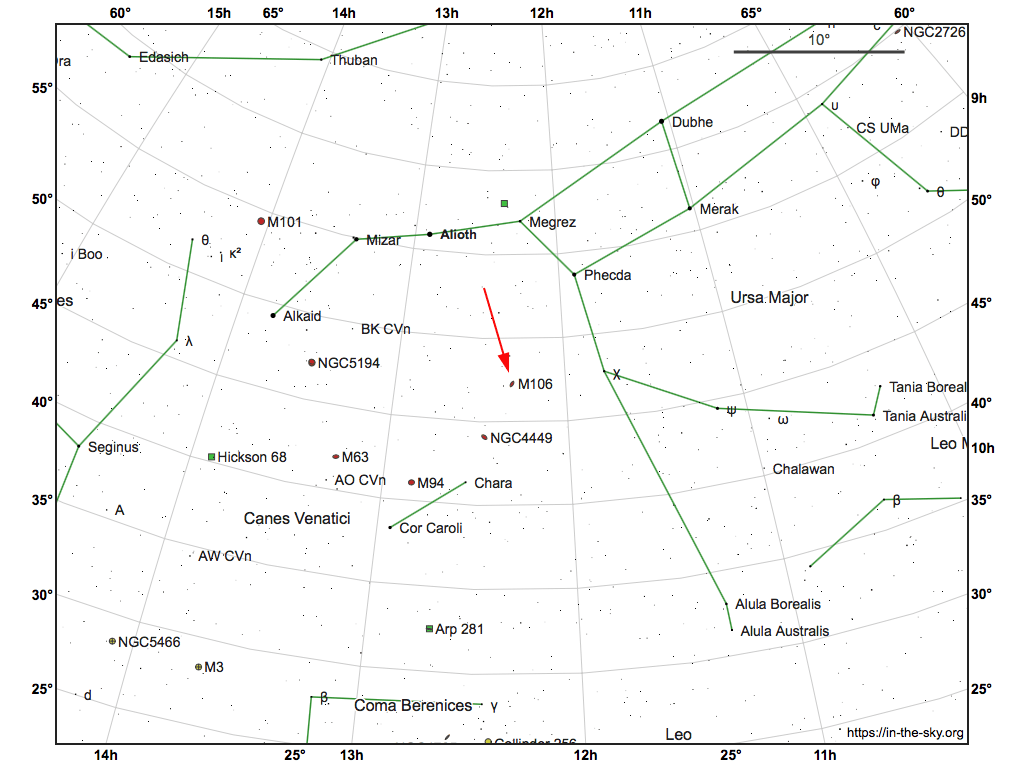
M106 is an intermediate spiral Type SAB(s)bc spiral 22 to 25 million light-years from Earth in constellation Canes Venatici and its diameter is 135,000 light-years. M106 has a relatively bright apparent magnitude of 8.4 and can be spotted with a small telescope. This galaxy was discovered by Pierre Méchain, an observer assistance to Charles Messier in 1781.
M106 contains an active nucleus classified as a Type 2 Seyfert, and the presence of a central supermassive black hole has been demonstrated from radio-wavelength observations of the rotation of a disk of molecular gas orbiting within the inner light-year around the black hole.
This galaxy played an important role in calibrating the cosmic distance ladder. M106 contains metallicities Cepheid variables to our Milky Way and other like galaxies’ Cepheids, which enable astronomers to re-calibrate other Cepheids with different metallicities. This improves the qualification distances to other galaxies.
The list below exhibits the number of subframes used with the exposure time for each filter. All the subframes were calibrated with Flats, Darks and Biases by PixInsight. Afterwards the subframes were combined and processed to the final image.
- Luminous 30 X 600s
- Red* 17 x 450s
- Green* 17 x 450s
- Blue* 16 x 450s
- Ha 12 x 1200s
* 2×2 binned
Total time for collecting data for this image is 15.3 hours.
 Frank's Observatory