Galaxy Morphological Classification*
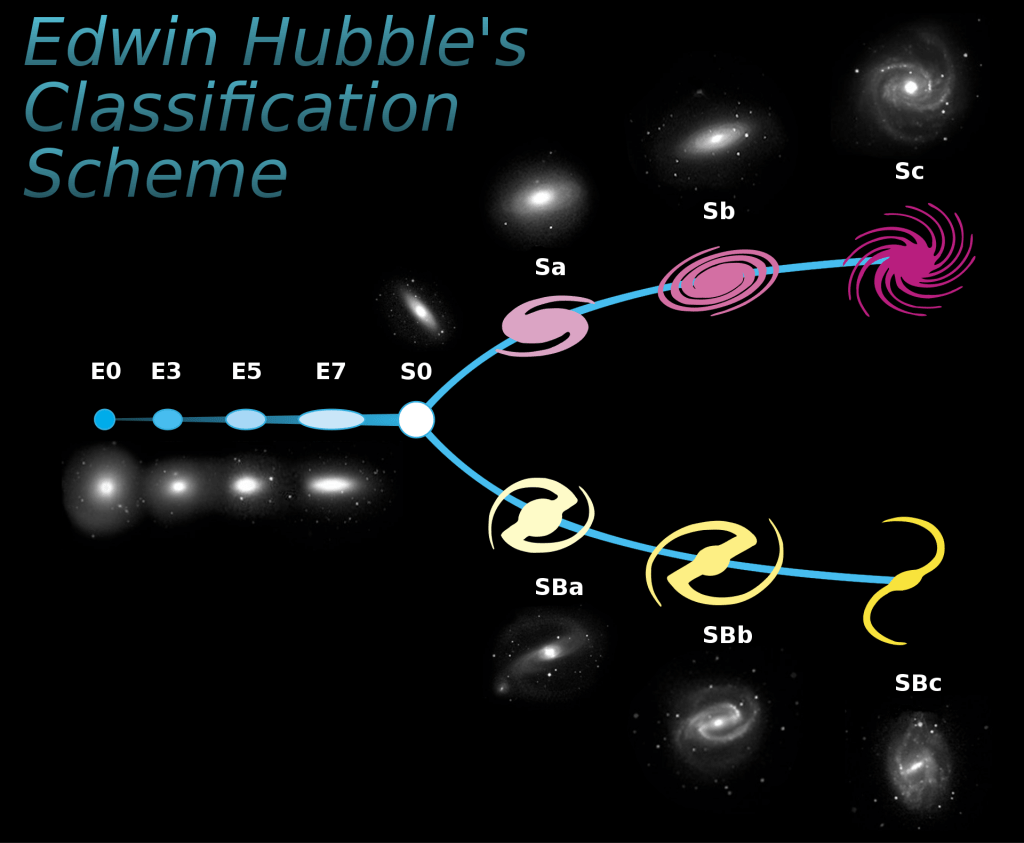
A well-known astronomer, Edward Hubble introduced the galaxy morphological classification in 1926. Also known as the tuning fork and is still referenced to this day. The galaxies on the stem of the tuning fork are classification for ellipticals E and a lenticular SO.
E0 elliptical indicates a spherical galaxy without arms. With increasing number, the ellipticals become increasingly elongated.
S0 galaxies depend on recognizing the presence of a disk and a bulge at minimum without spiral arms.
On the upper tine of the tuning fork the galaxies are designated as S and the lower tine are barred galaxies SB. As for the sub-types, going from a to c, the bulges get smaller, and the spiral arms less tightly wound. These sub-types are divided further that lies between two sub-types, for example Sab.
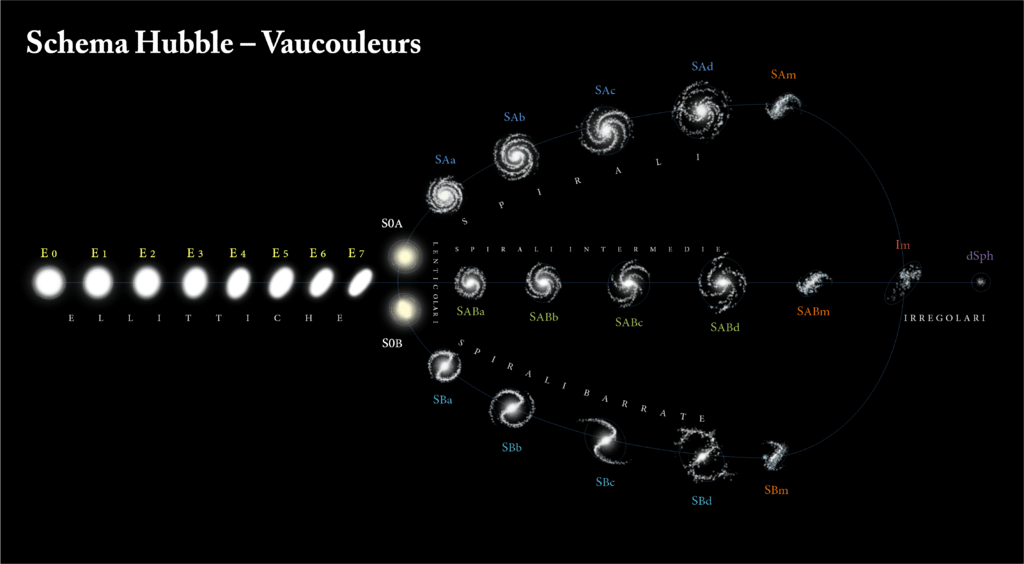
In 1959, de Vaucouleurs introduces a modified version of Hubble’s tuning fork. Vaucouleurs added a third tine between Hubble’s tines and these galaxies are the intermediate spiral galaxies SAB. They transitional between the unbarred galaxies SA and the barred galaxies SB. Note that the unbarred galaxies were re-designated from Hubble’s S to SA. Also note that there are additional elliptical galaxies.
The lenticular now has two classifications, one with no bars SA0 and with bars SB0.
Vaucouleurs introduced irregular galaxies with some spiral arms to the end of each tine; SAm, SABm and SBm. And one without arms IM is added to the end of the middle tine along with another type of galaxy, a dwarf spheroidal galaxy dSphs.
There is an additional pair of letter classifiers between the type and sub-type labels. Galaxies with ring structures are labeled with (r), those without ring structures are labeled (s) and the transitional cases are labeled (rs).
And a label (R) before the type indicates an outer ring-like structure.
A subsequent word ‘pec’ means peculiar; odd in some other way
* https://www.physics.unlv.edu/~jeffery/astro/galaxies/galaxy_vaucouleurs.html
 Frank's Observatory